

How men can find new purpose as a gender in ‘crisis’
The decline of younger men in the workforce has led some people to declare a crisis or even a war on men. Over decades, fewer men have been getting post-high school education or been a part of the workforce. Men are also less likely to be in committed or married relationships, shifting their long-standing role as breadwinners. Why and what comes next is a topic economist Ariel Binder has long researched. There is no simple answer.
Matt Carmichael: Do you think men are in crisis?
Ariel Binder: I would push back on that narrative of men being less valued by society and of the standard wage labor jobs with security and benefits that they used to be able to get not existing as much anymore.
Matt Carmichael: So where do men stand these days?
Binder: Despite my having pushed back against the crisis narrative, change is painful, and these are accumulated decades of change with men ceding some power in the household and the labor market to women is difficult. That may lead to these malaise types of narratives of men feeling unmoored and unsure of their purpose.
Matt Carmichael: How should men adapt?
Binder: As women have had this tremendous rise in labor force participation and education over the last several decades, they have dynamically responded to opportunities and shifts in the economy. Men ought to be held to the same narrative. Situations have changed and they should be thinking about how they spend their time and skills and vocations that they invest in.
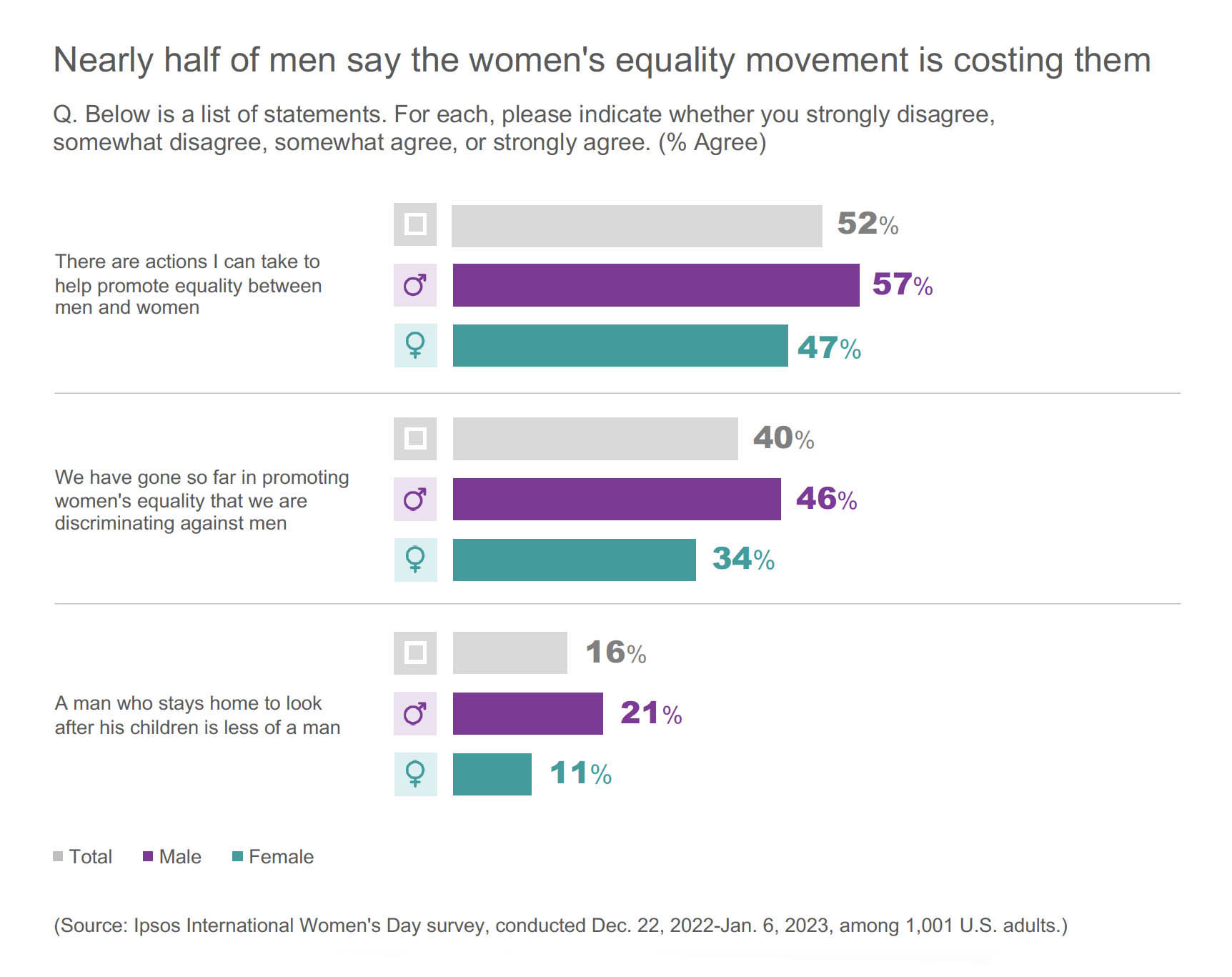
Matt Carmichael: Will men do more around the house if they’re not as engaged in the workforce?
Binder: There's this very stubborn fact that conditional on equal labor market opportunities, women perform more childcare and housework than men do. There has been progress, revising this male breadwinner norm. So maybe increasing numbers of men will have occasional employment spells and do other productive types of potentially non-paid labor that we should be thinking more about as a society. Before we label this a crisis, I would want to see more holistic engagement with what these men are doing outside of working hours.
Carmichael: One could argue that the economy was quite productive in eras where few women were in the workforce. Can’t it survive without as many men now?
Binder: Given how productive the economy has become in fulfilling basic needs relatively cheaply, it's not necessarily a bad thing that you might see more time spent out of the formal workforce, more leisure taking, more engagement with volunteering and other ways of spending time.
“I would push back on that narrative of men being less valued by society and of the standard wage labor jobs with security and benefits that they used to be able to get not existing as much anymore.”
Carmichael: So, we’re seeing both a disruption in workforce and in gender identity. How will AI impact all of this?
Binder: We're still a long way from self-driving cars and things that can fully replace humans, especially labor like construction, transportation and the sort of manual vocations that employ a lot of men. But as far as more creative occupations that don't involve manual labor, AI could complement those types of positions.
Carmichael: That sounds hopeful…
Binder: I would hope that it could be a productive part of the solution by removing some of the boring tasks and allowing people to spend more time on these valued tasks that could bring more of these men back into a feeling of self-worth and productivity in the labor market. It's exciting and it's uncertain.
Carmichael: Again, a lot of these trends are not new. Do you see them continuing or changing in the future?
Binder: Never ask an economist to predict the future.
Carmichael: Well, in foresight we talk in terms of what’s plausible…
Binder: As far as household and family trends, I see a continuation of more nontraditional families emerging, with men shifting into nontraditional roles in the household. We have seen an uptick in fertility lately for the first time in a while after the pandemic, but whether that’s a blip or whether that signals an increase in feelings of prosperity and hope for the future that results in more men being involved in these breadwinner roles is hard to tell. I think that that we're still going to see gender roles become more blurred and men continuing to have to contend with that and think about how they readjust their own priorities.
|
← Read previous |
Read next → |