

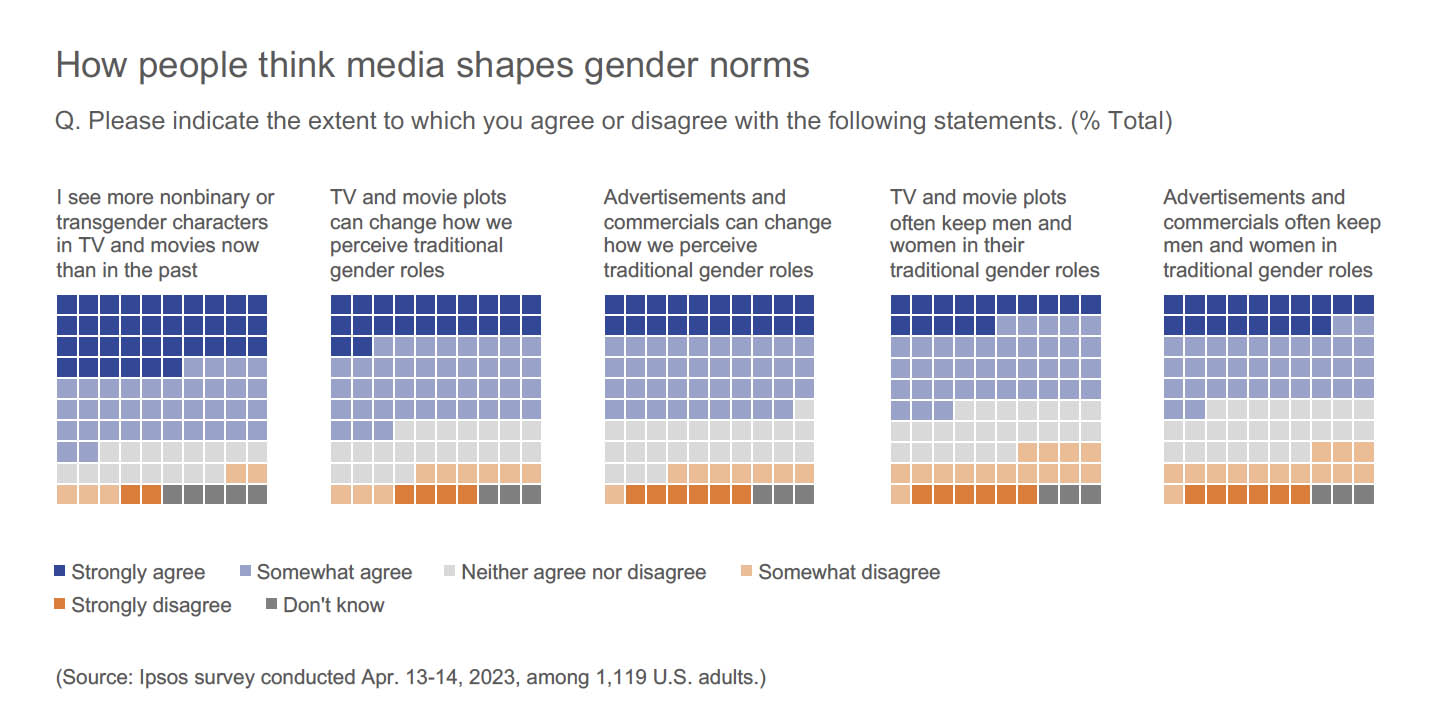
Signs that media is shifting gender perceptions
Women won’t realize gender equality for another 132 to 300 years, depending on who’s doing the measuring. It’s an economic, educational and access issue, and it shapes societal perceptions overall, says Latha Sarathy, EVP, analytics, insights and measurement at SeeHer ANA, a division of the Association of National Advertisers. But so can media and marketing. Sarathy says new research signals potential shifts for how media depicts gender and how brands will target and communicate with people in the future.
Kate MacArthur: What’s the progress in how women are represented in media since SeeHer began?
Latha Sarathy: SeeHer spearheaded development of the Gender Equality Measure, or GEM, in 2016. It is open source and has been leveraged by Ipsos for the last five years, which is awesome. We've tested close to 300,000 ads across 14 markets, which represent 97% of global ad spend. Year-over-year, we've proved how the accurate portrayal of women drives brand health metrics and actual sales.
MacArthur: What signals are you watching on gender representation for the future?
Sarathy: We've just finished a study looking at [Gen Z] perceptions on gender identity and sexuality. What the study has shown us — which was really an a-ha moment — is not just that they are more aware of fluidity of gender identities, they're a generation that has embraced that idea more so than any other. Even those who may not personally believe that gender is nonbinary support those who do. That's big. And the acceptance of different gender expressions and gender identities impacts the media and marketing ecosystem at the most basic level. It also impacts how we talk to this generation. If we need to rethink how we target male, female, age and gender like we used to, we have to unpack those paradigms and think differently.
MacArthur: How does gender being more fluid shape how you look at testing and insights?
Sarathy: We have to be very intentional about testing across all gender and nonbinary identities and develop detailed insights and new norms. And thinking about traditional gender identities, we have to be very thoughtful about how we depict men as much as how we depict women. For women, the point is that we still have not leveled the playing field. But for men, how can we nuance their portrayal as well so there is true equality? That's the starting point.
MacArthur: Some female public figures promote themselves using sexualized imagery. How does that influence what gets contextualized as women’s empowerment and representation?
Sarathy: Let's go back to the Gen Z example. They believe that men and women can express themselves any way they want. But when we think about the marketing and advertising community, we need to take into consideration all segments of consumers. Change is not always straightforward, right? Certain elements of society may pull us forward and some may pull us back, but we need to move forward very intentionally and thoughtfully — and that’s where insights are so useful.
“If we need to rethink how we target male, female, age and gender like we used to, we have to unpack those paradigms and think differently.”
MacArthur: Immersive media and AI are rapidly changing and influencing broader media. How do they influence the goals for gender representation?
Sarathy: We all have built-in biases, many unconscious, that can get translated into the tools we create. When we think about gender representation, we need to consider how we can reduce these biases as much as possible. This is where a tool like GEM testing can be so effective. The predictive drivers framework that we created with Ipsos provides real prescriptive diagnostics on how we can optimize gender portrayal — of both women and men.
For example, showing women actively pursuing their own goals as well as being caretakers is a strong driver of high GEM scores. We need to ensure that the ad testing and creative development process, which is becoming more and more AI-driven, is actively mitigating for gender bias.
|
← Read previous |
Read next → |