
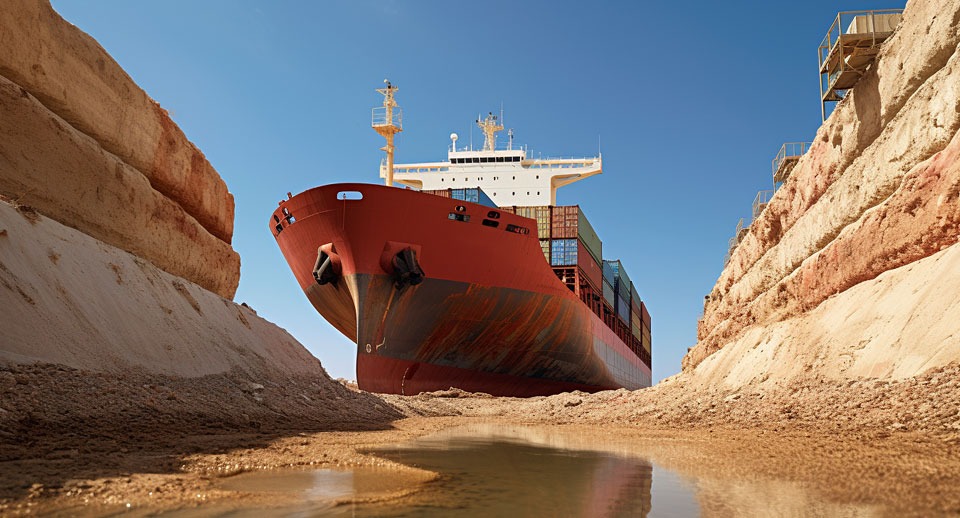
Why considering the worst case needs to be part of your planning
The National Intelligence Council’s role is to coordinate perspectives across the nation’s 18 intelligence entities from the CIA to the Department of Energy and connect them with U.S. policymakers. In her previous role as director of the Strategic Futures Group in the Office of the Director of National Intelligence, Maria Langan-Riekhof led the development of the latest quadrennial Global Trends report subtitled, “A More Contested World.” So, what does that conflict mean for the future?
Matt Carmichael: How is the world “contested”?
Maria Langan-Riekhof: We are seeing contestation at every level of analysis that we're engaged in, from fundamental debates about the ordering principles of our societies, discussions about what is “real” or what is “truth” to growing tensions between publics and their governments and their leaders. We've seen more than a decade of rising numbers of protest movements in every region and every type of government system. In the past year there have been an incredible number of coups and coup attempts.
Carmichael: What can you already tell will need updating in the next report?
Langan-Riekhof: We are just a couple years into this 20-year report [the time horizon was 2040]. We're already seeing something that we started to identify but didn’t draw out: a discussion of the pace of change in the world. It's exceeded our projections, whether we're discussing demographic trends such as declining birth rates in China or when India would overtake China as the largest country. We said that wouldn't happen until 2027, but it's already happened. Or when environmental changes would have an impact. AI large language models arrived faster than we thought they would. It's a combination of increasing speed of change, the scope of change and the depth of change that we need to do a better job of capturing for this next report.
Carmichael: What kind of impact does that have?
Langan-Riekhof: It's challenging humanity’s ability to adapt. In previous decades, you’d face one to three major changes in the systems that structure how you live, work and entertain yourself over your lifetime. Now, humans are facing those major changes every few years. What does that look like? Humans are going to be forced to redefine a lot of our relationships, between individuals and societies, between societies and corporations, governments between states and non-state actors, and between people and our own technologies. Redefining relationships in the midst of this increasing pace of change is one thing we're really going to have to grapple with in the next report.
“We are just a couple years into this 20-year report [the time horizon was 2040]. We’re already seeing something that we started to identify but didn’t draw out: a discussion of the pace of change in the world.”
Carmichael: How do you use foresight in your process?
Langan-Riekhof: We create multiple, diverse scenarios to better understand the present and specifically how human choices interact with key structural forces to affect the direction of the world. Then we try to illustrate the impact of those choices. So, we ask questions about what states — and that usually means leaders — prioritize. Are they prioritizing security? Economic development? Nationalism? We ask questions about how states are engaged in the world. Are they cooperative and outwardly focused? Are they competitive and inwardly focused? And then we overlay that with some of the conditions of the big muscle movements that are shaping the world.
Carmichael: We’ve seen a shift toward territorial expansion. What does this signal to you?
Langan-Riekhof: It’s signaling to us that we’re going to be in a very unsettled interregnum in the global order for at least a decade. It’s going to be heavily influenced not only by the strategic competition we’re talking about between the major global powers (U.S., China, a declining Russia) and leading to challenges and strains, whether we're talking Taiwan, the South China Sea, Ukraine. But our more empowered regional countries are highly relevant.
Carmichael: How do you see climate change affecting global systems?
Langan-Riekhof: We think that climate change can stress and really disrupt our trade networks in in several ways. First, stemming from the physical effects of climate change, extreme weather disrupting trade networks and supply rates. Second is from the state efforts to decrease carbon emissions. Those policy changes are trying to affect other states and how they are complying with those can also disrupt trade networks.
Carmichael: How, exactly?
Langan-Riekhof: All you need is one major hurricane or cyclone in the same vicinity of a port. And we haven’t even talked about other strains that could compound that like a cyberattack. I don't think we should ever look at any one of these in isolation. We need to think about these challenges and how they overlay each other and could compound each other and to make any of these strains, whether it's on trade or supply routes, exponentially worse.
|
← Read previous |
Read next → |
For further reading
Worry about possible worldwide conflict rises
Majority of Americans continue to support Ukraine, but have mixed views on war outlook