

Why humans plus AI are key to revolutionizing healthcare
In the five years since What the Future first interviewed Dr. Kyu Rhee on the impact of artificial intelligence in healthcare, the technology has boomed. In that time, Dr. Rhee has moved from chief health officer at IBM to chief medical officer at CVS Health. In mid-August, he’ll join the National Association of Community Health Centers (NACHC) as its president and CEO. Over time, his views on AI have become only firmer: Humans plus AI are key to making healthcare more efficient, effective and equitable and a better experience.
Kate MacArthur: When you spoke with What the Future in 2018, you discussed how AI could remove some administrative burden for doctors and that patients needed to trust doctors to protect their data. How is that compromise evolving?
Dr. Kyu Rhee: I still believe the core of healthcare is a patient and a provider. Then the responsibility of AI is how it supports that relationship. I also believe the providers who don’t use AI will be replaced by those who do, and that is slowly happening.
“I still believe the core of healthcare is a patient and a provider. Then the responsibility of AI is how it supports that relationship.”
MacArthur: Where do you see AI having the greatest impact in healthcare in the next decade?
Dr. Kyu Rhee: I’m going to go from what I call follow the data — and even the money — in healthcare. Start with the patient. There are opportunities where algorithms can nudge patients to the best healthy behaviors, and it’s still the patient’s decision. Then you go to the provider. Two key areas where AI can be leveraged effectively is transitioning their role as a data entry clerk. We know half of each visit is spent entering data into an EMR [electronic medical record] to document that visit.
The hope is an AI digital scribe will reduce that time significantly. We spend a lot of time on administrative burdens like prior authorization for either drugs or procedures. The future of AI-supported prior authorization would allow immediate approval before you leave that exam room.
MacArthur: How do you make sure that people aren’t being rejected for care because the AI was trained poorly?
Dr. Rhee: You have to be transparent about the biases associated with the datasets you’re using, and you have to do your best to ameliorate or reduce those biases. My personal belief is you can never eliminate bias in data completely.
MacArthur: As a doctor and AI expert, how does the risk of catastrophe from AI rank against societal-scale risks, such as pandemics and nuclear war?
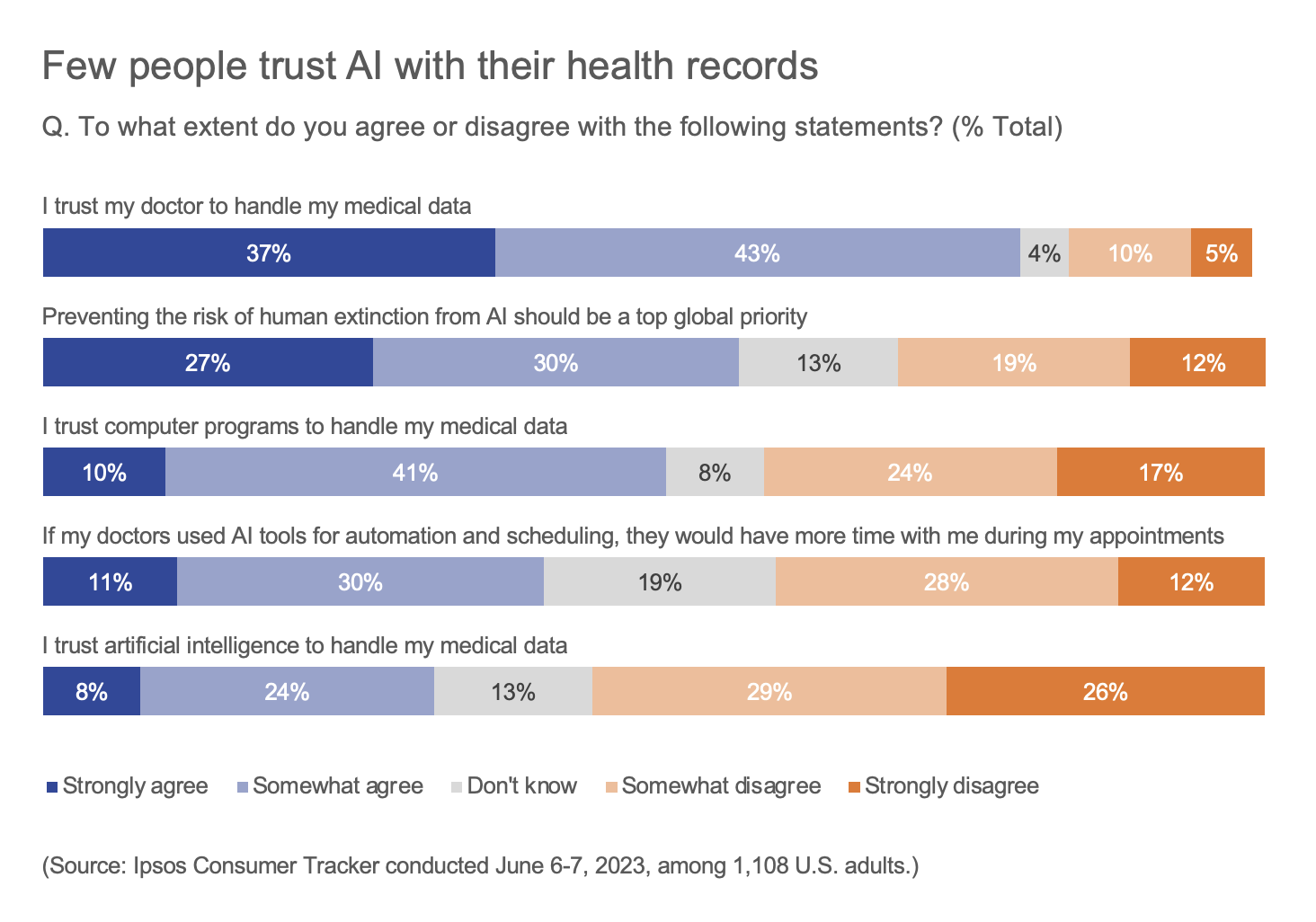
Dr. Rhee: I don’t think, as some have stated, that AI inevitably will lead to the destruction of our health system or anything like that. Now what I do worry about is if we start to trust the AI more than we trust the humans. Healthcare is all about trust in human-to-human relationships. AI should support that.
MacArthur: How so?
Dr. Rhee: I saw this in certain cases where a patient might say, “Wait, what is the AI algorithm saying? That’s what I want.” And the provider’s saying, “I don’t agree with the AI algorithm. I have a lot of experience. I think it helps me, but ultimately this is what I recommend.” As a provider, I can tell you why I’m ultimately accountable. Ultimately, that’s an opinion. That’s something I believe patients should have access to.
MacArthur: So, what’s the solution?
Dr. Rhee: As we create more AI and data literacy, part of building trust with the patient is creating complete transparency. You’re the ultimate payer of our health system. You should see the outcomes of what you paid for, including the data that’s produced and the insights that are created.
MacArthur: Some people believe AI can eventually be smarter than we are. Are you in that camp?
Dr. Rhee: It depends on what you define as smart. It can know from an IQ perspective certain things, but to me healthcare is so much more than just IQ, it’s about EQ [emotional intelligence]. It’s about SQ, social intelligence. The AI algorithm will only know what it’s taught, and there’s so much that’s not teachable in data, and there’s so much that’s not in the data. The combination of human plus AI will be better than just humans only. I don’t think it’s as transparent to most people as it should be, but as that transparency becomes more visible, I think there will not be a provider who doesn’t use AI.
MacArthur: How should AI be built to be more helpful for healthcare?
Dr. Rhee: Your workforce should represent the people you serve in healthcare and in health technology. We have not done a good job of female and minority representation. My call to action is that people should have better representation whether it comes to data scientists or the C-suite in healthcare and health tech companies.
|
← Read previous |
Read next → |