
Why news literacy matters more than ever for future generations
News literacy, or media literacy, means a lot of things to different people, even those who teach it. That’s a challenge for the News Literacy Project, a nonpartisan, nonprofit that provides training to K-12 educators, including tools like the Checkology virtual classroom. The 2016 election brought a lot of attention to issues about online (dis)information and influence. When he thinks about the future, NLP’s Peter Adams is focused on helping students understand how to wield the power of skepticism in the digital age.
Matt Carmichael: My parents knew their kids would read anything they left on the breakfast table. How did you get news as a kid?
Peter Adams: My mom used to glue articles to the back of the cereal box because we’d stare at it when we ate.
Carmichael: What’s being done broadly about teaching media literacy and why is it important?
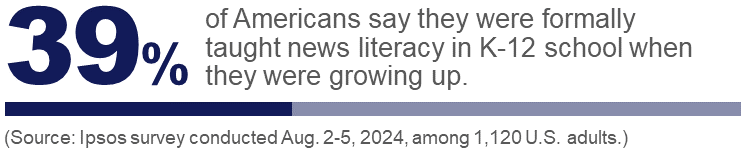
Adams: Illinois was one of the first states to introduce a media literacy graduation requirement. Other states have passed legislative endorsements of the idea. But students are inheriting the largest and most complex information environment in human history, by many magnitudes. If we don't teach them media literacy, we're actively disempowering them civically. We kind of owe it to them.
Carmichael: Is media literacy itself becoming polarized, especially in schools?
Adams: We are rigorously nonpartisan, but even with the idea of teaching students how to evaluate credibility, there are bad faith partisan actors who are trying to make that political or controversial. There are folks who would prefer you not teach the idea that
there are provably false claims and how to detect them.

Carmichael: How do you bridge those conflicts?
Adams: No one thinks that journalism or information or news should be inaccurate. Accuracy shouldn't be controversial to affirm. No one thinks it shouldn't be fair or transparent. No one thinks news organizations shouldn't correct errors when they happen or be independent of advertisers and ownership and partisan influence. If we can agree at least on that much and then go from there, we can have all sorts of interesting and engaging conversations around what fairness and accountability should look like in practice. That's relatively safe territory for educators to get into.
Carmichael: So what do you teach in this context?
Adams: Our founder realized as a career journalist that we're all vulnerable to making assumptions that feel concrete. We're vulnerable to cognitive biases, we're vulnerable to affirming the things we think we know but verifying them is the discipline of journalism.
“Students are inheriting the largest and most complex information environment in human history. If we don’t teach them media literacy, we’re actively disempowering them civically.”
Carmichael: What could journalists and news organizations do to make your task easier?
Adams: News organizations could do a better job of explaining how they do their work. They could clarify for people the distinction between different kinds of journalism, help them understand different terminology or style decisions and things like that.
Carmichael: People are interested in news, but sometimes that takes the form of “doing your own research.” What do you teach kids about that?
Adams: We help students understand what sound reasoning is in the first place, help them understand that we have an innate tendency to engage in motivated reasoning and other logical fallacies and that cognitive biases affect everything we do and think unless we guard against them. That's No. 1.
Carmichael: How do you teach the value of news, and that it needs to be paid for somehow?
Adams: Other industries like Hollywood struggled with that same question of how they protect their intellectual property in a digital world. With streaming, there's a solution now to access that stuff for a reasonable cost. The idea that because quality journalism — just like a high-budget Hollywood movie — takes capacity and people with skills to produce, that can’t be free. But on the news side, people just say, “Well if I hit a firewall with this high-quality source, I'm just going to go find it somewhere else.” They don't make that same mistake with movies. It's not like they hit a paywall with a top-tier box office film, so they just go watch B movies. Somehow, we haven't broken through in that same way with news.
← Read previous | Read next → |