
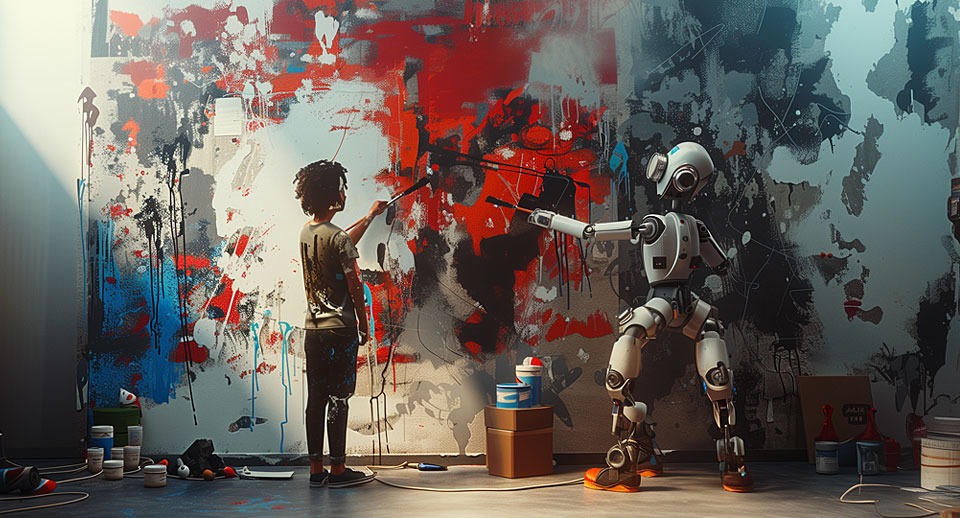
How AI will help tomorrow’s creators push artistic boundaries
As a professor at the Rhode Island School of Design (RISD), Daniel Lefcourt teaches first-year students practical skills and critical thinking in courses influenced by everything from pre-Columbian architecture to the Bauhaus movement. He thinks generative tools will enable individuals to express themselves in entirely new ways — and that those trained in the arts will have an advantage in an increasingly visual culture. But he thinks it would help if the companies designing those tools would get artists in the room.
Christopher Good: How do you teach the arts at a time when AI is transforming how we view it?
Daniel Lefcourt: My job as an art professor is to bridge the gap between past and present, and to make connections to the history of art and design. Rule-based systems and randomization — the key components of AI art — have been in artists’ toolkits for hundreds of years.
Good: So, how do you teach (and use) AI in the classroom?
Lefcourt: In some ways, my students and I are asking questions together. Supposedly these tools are going to totally transform the world and transform every field: architecture, industrial design, illustration, etc. I'm excited about that possibility. But every tool has limitations. I see my role and my students’ role as finding out what the outer limits of the possible are.
Good: Those limitations can inspire artists, right?
Lefcourt: Totally! Exploring the limits of any tech is an art form. Like ‘80s punk zine graphics made with Xerox machines. Or with turntables and hip-hop. They had to figure out how to push the tech to make these new art forms! It’s the same with AI now. It’s wild how all these images that look so realistic to us right now will, in a few years, look quaint and distorted. Which is also true of 3D graphics, or any technology, really.
Good: Why should artists use AI in their work?
Lefcourt: With my students — the ones that hate AI or those that just say it’s not their style, which I would say are the majority — what I’m arguing for is that you'll be able to do more as an individual. If I want to make a full feature film, I can design the characters, I can do all the voices. I can edit it. That, to me, is interesting. And I think new forms of storytelling are going to come out of this.
Good: You can make things faster with AI. What are the consequences of that?
Lefcourt: If we're just interested in doing what we're currently doing, but faster and cheaper to get labor costs down, that’s an extractive model. Thinking like this is a dead end, because if a certain type of content starts to get cranked out by AI, then that content loses value. This pattern is not new. I mean, look at modernist architecture. You have the early masterpieces, and then you get office parks that are cheap knockoffs. I would draw a contrast between an extractive approach to AI and a truly generative one. What I’m interested in is: What is this amazing new medium, and what sorts of films and images and games can we make that have never been seen before?
“What I see is a culture that’s going to become vastly more visual. More images have been produced this year than in all of human history, right?”
Good: Does that impact the value of an arts degree?
Lefcourt: For us, it’s more about teaching critical thinking skills and how to approach these tools speculatively.
I'm old enough that I learned commercial illustration as a teenager using paint and an airbrush. I can't even tell you how slow it was. When Photoshop was adopted by the industry, there was a panic that we would all be out of jobs because it was so much faster. But Photoshop and early CGI produced the multibillion-dollar game industry, and there was a generation of illustrators that made an incredible living off that industry. What I see is a culture that's going to become vastly more visual. More images have been produced this year than in all of human history, right? Going to art school positions you to be at the forefront of this new visual culture.
Good: What should our readers be thinking about?
Lefcourt: I’ve been speaking to a lot of people in the industry over the last few years, and there’s a shocking lack of real artists, designers and writers involved in making AI tools. The tools are being made, and then they’re asking creatives afterwards if they like them. And I would argue that they are often building the wrong tools! I think whoever develops collaboratively with creatives is going to have a serious competitive advantage — along the lines of what Steve Jobs did by bringing in Jony Ive [as chief design officer]. The value of these new tools is still speculative. You need to get far closer to the actual people who intend to use these tools.
| ← Read previous How AI and human insights can help designers think out of the box | Read next → |