
How ‘generative reality’ will become a new art medium
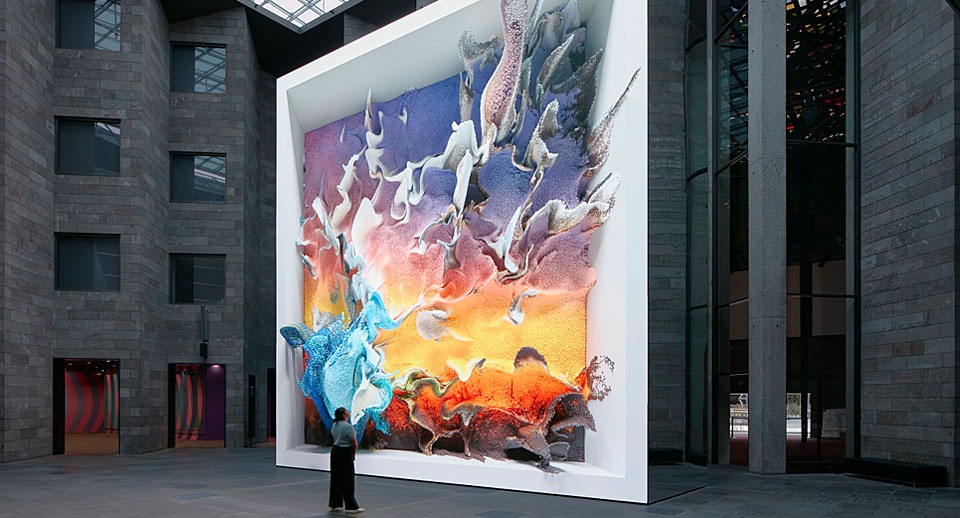
What happens when you essentially create a new art form? You have to invent a lexicon alongside it. Refik Anadol’s 20-person studio team creates AI art, sure. But first it captures billions of photos to train those custom AIs on. The result is art that seems to live and move and “dream” at installations at the Sphere in Las Vegas and at the New York Museum of Modern Art. He describes this medium as “data painting.” When he thinks about the future of art, he’s thinking about how new tools can help capture and visualize human memory.
Matt Carmichael: Clearly, what you do is not the same as giving one of the AI chatbots a prompt. How is your approach different?
Refik Anadol: I was the first artist-in-residence at Google, which allowed me and my team to learn how to use AI way before what we have now. I focus on using collective memories of humanity, meaning topics such as nature, space and public urban culture, things that are not individual, but rather more about the societal interests that I hope everyone loves and cares about. We train our own models with our own datasets. So that's a very different approach. But the context here is to make a “thinking brush” where I am aware of the pigment and the memory, and how this AI could dream [and] hallucinate, then I try to create a mimic reality.
Carmichael: My kids described your work “Unsupervised” at MOMA as hypnotic.
Anadol: Our work can create a positive impact about paying attention and letting us focus on something else to create a flow state, not a meditative state. “Unsupervised” received 38 minutes of average viewing time. Because our work is focused on a living artwork, meaning it's not a frozen pigment, it’s in flux. What happens if data becomes a pigment? They can move, shape, create color, form patterns. One of the reasons “Unsupervised” has this very positive impact and engagement is coming from this machine hallucination.
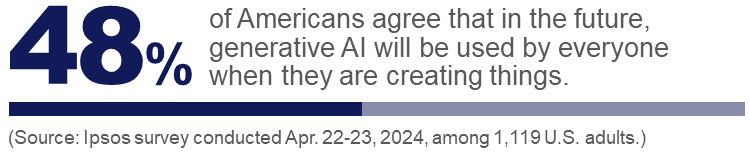
Carmichael: In our Future of Creativity survey, people were split on whether AI is a tool just like any other. What do you think?
Anadol: For me, AI is a cognitive enhancement of our mind. When I think about a tool, it's more like a physical object or a keyboard or mouse. AI is more than that because it enhances our thoughts, our reasoning and our creativity.
Carmichael: How do you view AI?
Anadol: It’s inspiring to think about AI as a friend. Here, a being is appearing in our life. They have some voice, they have some character, they can be joyful, they never get tired. They’re encouraging you to contribute new ideas and concepts and so forth. It's a fascinating dialogue, and we’ll have machine-human collaborations more and more. I call it “finding human in non-human.” It's a fascinating new dialogue we are going through.
Carmichael: People used to question if photography was art. Do you think we’ll debate whether AI is art in the future, or will we get over it?
Anadol: I don’t think questioning if it's art or not will be relevant even in a couple of years. Machines will make art. Machines will be a part of our life and they’ll be blended invisibly. That’s a predictable future. I find it powerful and inspiring to think of this machine as a thinking brush. It doesn't forget. If I want to paint with all the flowers or trees or clouds in the world, that’s making art with a new type of pigment, a new type of brush and a new type of canvas.
“Artists are always the alarm mechanisms for humanity. We highlight what may happen next and warm up society and bring all the questions, so society feels comfortable when the societal shift happens.”
Carmichael: What role will artists play in the future?
Anadol: Artists are always the alarm mechanisms for humanity. We highlight what may happen next and warm up society and bring all the questions, so society feels comfortable when the societal shift happens. I asked almost a decade ago if a machine can learn, can it dream, can it hallucinate? These are the questions we are now actually exploring in creativity.
Carmichael: Do you think in 2008 you would have imagined what you were working with now? What do you think you will get to play with in 2044?
Anadol: We will be entering this very inspiring era. I'm calling this new medium “generative reality.” I love the physical world. I love nature. I am not trying to replace anything at all. If you’re watching a movie, it's not real, but feels real. We will create realities and these realities will have multiple senses and this will be a whole new imagination. Cinema will evolve, music will evolve, opera will evolve, every form of art will evolve.
| ← Read previous Why AI shouldn’t be used as a shortcut for craftsmanship | Read next → |