
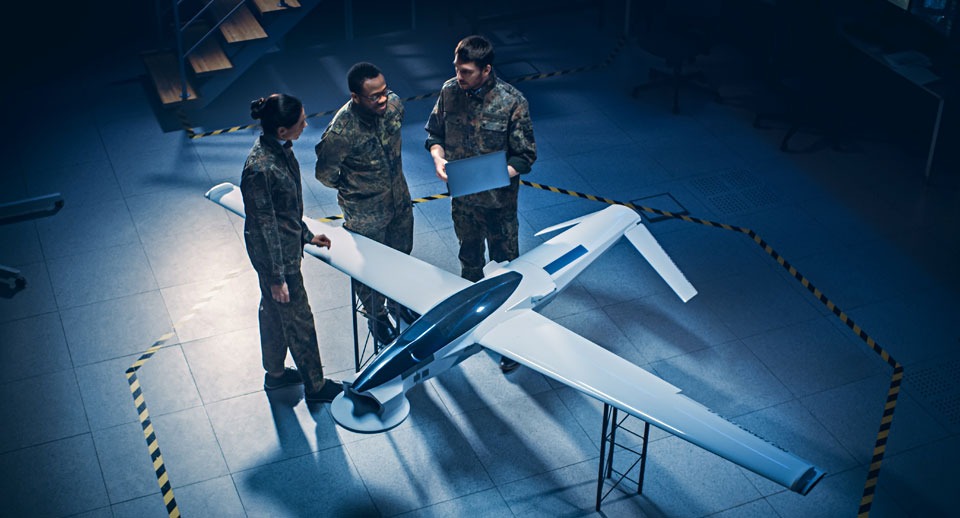
How improving tech literacy among policymakers would strengthen security
When the pandemic began, the Air Force released a series of scenarios from its foresight team that included discussion of how if there was prolonged reduction of commercial air travel, that would free up more sky space for military training flights. The future of conflict has some different takes on events than the rest of us need. Jake Sotiriadis was then serving as the first futurist for the Air Force. Now at National Intelligence University, he is thinking even more broadly about the future of conflict. Here’s what’s on his mind.
Matt Carmichael: What do you factor in when you're forecasting conflict?
Jake Sotiriadis: Conflict is part of the human condition. We have to look geopolitics. We have to look at the power of ideas. I like to look at the Heidelberg Research Institute’s Conflict Barometer that looks at every conflict in the world from basically a brush fire all the way to Ukraine. It’ll break down the origins of the conflict. In many cases, we'll see ideology being at the forefront.
Carmichael: Humans have warred over religion, power, money and resources. Are the causes of conflict going to shift?
Sotiriadis: We’re looking at a different global sense of not only governance, but rules, if you will. Part of what's going on in Ukraine isn't just about Russia and Ukraine. It's about, in the 21st century, are we going to allow countries to solve their differences using violence? That’s a message for China or autocratic regimes that think it’s going to be OK to just simply employ their militaries to achieve their goals. What happens in the next five to 10 years will determine the trajectory of the next 50 to 100 years.
Carmichael: How is technology itself shaping the future of conflict?
Sotiriadis: Technology has always played a major role, and often it’s the opposite equation where war has created the catalyst for technological developments. Consider today with narrative warfare. Look at the social media aspect of how narrative warfare shifted what used to be the purview of states. If you look at 50, 60 even just 40 years ago, the strategic narrative was controlled by a country, which had access to the media. It was able to put out its version of events. Now with everybody carrying around a smartphone, you’re able as an individual, to wage narrative warfare 24 hours a day. At the individual level, you're able to push a narrative across the globe in real time and spread disinformation, which has real effects.
“Frankly, the technology is so far ahead of the policy that it’s frustrating for those of us who are trying to push things in that direction. We’ve got to educate our decision-makers and senior leaders to take some bold steps to take advantage of the technology.”
Carmichael: With AI helping make decisions, will see more advanced forms of war gaming, even at the policy level?
Sotiriadis: We should be able to do that. But unfortunately, bureaucracies get in the way. I'll give you a great example: A few years ago, we built a virtual reality simulation of the world in 2035, focused on post-pandemic scenarios. But it wasn't just a scenario, it was actually stepping into a virtual world. As a decision-maker, you would understand better if you were in a collapse scenario or a transformative scenario. What does that feel like and look like? How would I make decisions differently? But I can't even tell you the frustrations of just trying to do something simple like bring a virtual reality headset into the Pentagon.
Carmichael: And I think my IT department is tough.
Sotiriadis: Frankly, the technology is so far ahead of the policy that it's frustrating for those of us who are trying to push things in that direction. We’ve got to educate our decision-makers and senior leaders to take some bold steps to take advantage of the technology.
Carmichael: How much are tech innovations being developed for defense versus being adopted from defense?
Sotiriadis: If you look back at the development of telecommunications or how the internet was conceived, designed, and now has morphed, those really originated in the defense realm. There is a direct connection in the national security ecosystem of driving a lot of our tech developments.
Carmichael: And the other way around?
Sotiriadis: I've been encouraged working on public- and private-sector partnerships. That’s taken the form of artificial intelligence working groups and collaborative lab initiatives and tech incubators. You have a defense innovation unit that's been set up particularly to put smart folks from the defense industry in Silicon Valley so we can get promising tech developments into place and into field as fast as possible.
Carmichael: How will wars end?
Sotiriadis: We live in a world that’s characterized by complexity. That’s more than just “is one country going to surrender?” If we're even going to talk about that in the traditional sense. But what other components are going to be a part of that? We're talking about disinformation narratives. We're talking about technologies that are going to completely distort how we understand strategic communications.
|
← Read previous |
Read next → |