
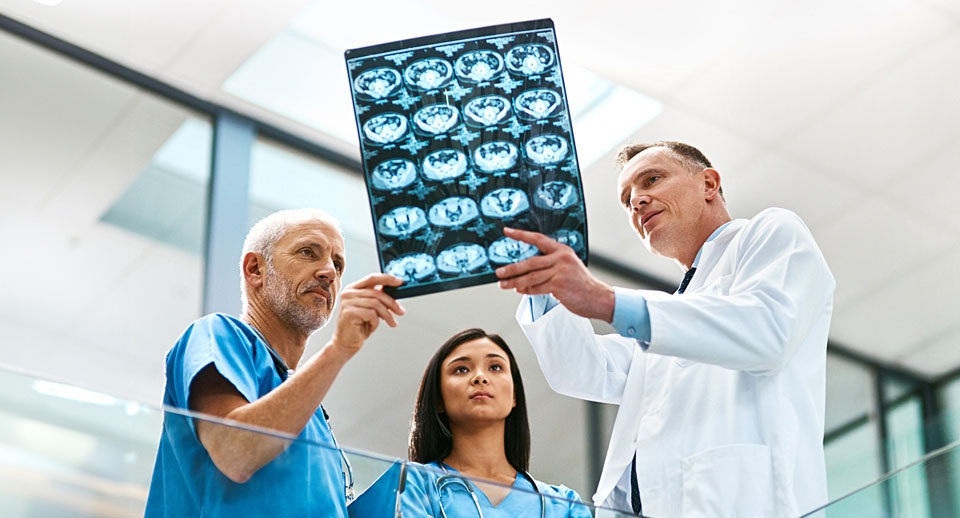
Why doctors and engineers are teaming up to make aging better
America is facing an eldercare crisis as the number of Americans age 65 and older will rise to 82 million by 2050, while growth among younger groups stagnates. Dr. Peter Abadir, an associate professor of geriatric medicine at Johns Hopkins University, is tackling this issue in multiple ways using artificial intelligence and other cutting-edge technology. His team at the Artificial Intelligence and Technology Collaboratory for Aging Research (AITC) aims to use technology to help adults live longer, healthier lives at home, even if family is far away.
Kate MacArthur: How do you define successful aging?
Dr. Peter Abadir: Successful aging is not simply the absence of disease, but independence, preservation of function and quality of life as people grow older. It's enabling our older adults to live meaningfully and stay engaged in their community, stay at home and maintain control over their health decisions. The next chapter in taking care of older adults is going to be co-written together between engineers, technologists and clinician scientists.
MacArthur: What are promising interventions to extend health span and delay age-related diseases?
Abadir: Some are the gait assessment tools we are building and the cameras we’re using to assess physical function in older adults. Those will allow a clinician to do what would take two hours to a few seconds or a few minutes. Another technology we funded through the AITC from a company that looked at sleep found that disturbance in sleep is a common complaint of a lot of the patients that came with cognitive decline. The market is full of medications that will put you in “coma,” but not really give you that deep, refreshing sleep. They worked on an EEG device that’s like a sports headband you wear, and it’s synced with a tool that emits pink noise, keeping older adults in deep sleep longer.
MacArthur: Government funding of medical research is being cut. What happens then?
Abadir: We realize that we cannot depend on the government forever to be the driver behind all the new advances and technologies. There should be some cost-sharing with industry, with philanthropy, with other entities that should support this mission. If we continue to depend on the government as a sole provider for this, we will not get anywhere.
MacArthur: Loneliness is a problem for this population. Are there solutions coming?
Abadir: There is no substitute for the human touch. But when resources are limited, maybe technology can provide less of an optimal solution. What we have been working on involves augmented reality and building glasses that can basically take you through the streets of Baltimore, and you interact with different people. This is a complicated issue that I don't think is going to be solved with one technology.
 We realize that we cannot depend on the government forever to be the driver behind all the new advances and technologies.”
MacArthur: What can help caregivers support their loved ones meaningfully from far away?
Abadir: I’ll share a technology we have been working on. It is a Wi-Fi-based technology that allows a caregiver to detect movement and falls at home. That router you have at home emits a Wi-Fi signal; if you have solved the algorithm, any disruption of that signal when somebody walks through the room or falls, you can detect that and send a signal to the caregiver that something happened. Another technology is cloning the voice of the caregiver, not just the tone but how you say different things, and to use that as a reminder for the loved one about medications, eating, etc. There is evidence that older adults with some cognitive impairment respond better to familiar voices.
MacArthur: What should businesses know about the urgent eldercare needs to be a part of the solution?
Abadir: I'll talk first about the workforce. Geriatrics nurse aides, trained nurses that take care of older adults, need flexibility, tools, resources, funding, financial support, and this is the foundation we will be building on.
Even if you have the most advanced technologies but no workforce to use it, then we won’t move a lot. Second is codesigning, coinventing. We call it Living Labs. How can we bring in investors and people with philanthropy to see the massive opportunity for innovation in aging tech, from financial tools to home safety to cognitive support, to invest in the development of the technology, in the scholars that will be developing the technologies, in databases that will be part of the future of deciding whether that technology is effective?
← Read previous | Read next → |