
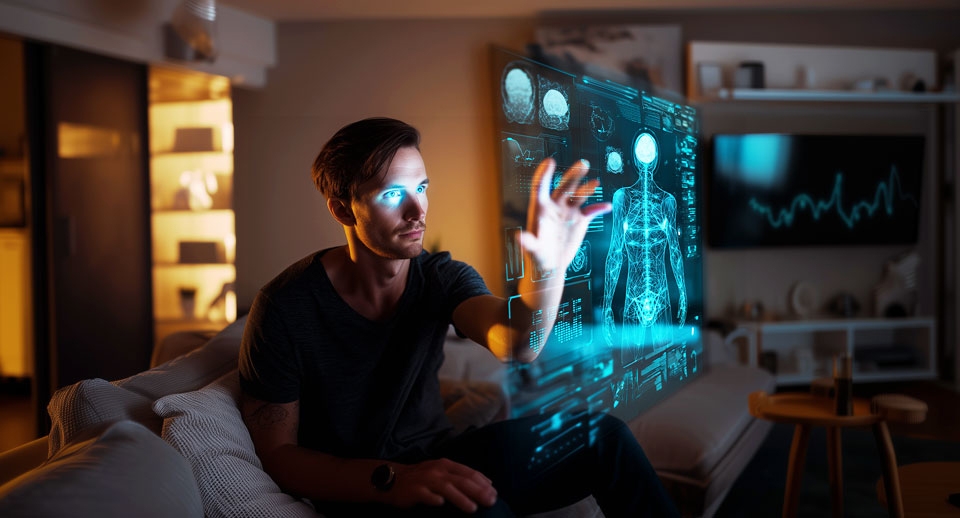
Who will guide our future wellness in a post-trust world?
Imagine it’s 2052.
What is the most important factor for your personal health? That was a topic we discussed in our 2018 Health issue with Dr. Sandro Galea, now the dean of the School of Public Health at Washington University. Then and now, the people we surveyed ranked their diet and genes as most important and public policy the least by far. Galea saw positives in that. If we think health is in our personal nexus of control, we’ll do what we can to control it. That gives people helpful agency.
But people’s lack of understanding of how much policy or social status matter is problematic. We need to “govern for health,” Galea told What the Future. “We need to make sure we make decisions that actually promote health. We need to make sure multiple sectors act in a way that generates health. That means to make sure when decisions are made about transportation or housing or income structure or employment, we recognize these have impacts on health.”
Since then, well, much has changed. There was a global pandemic in the middle, for starters. On the policy end, we know that for the foreseeable future public health will not look like it has. The Trump administration has a very different vision for public health than previous administrations. Research at the National Institutes of Health has been both cut and redirected in ways that will fundamentally reshape care in the present and future. What we don’t know entirely is how the new direction will spin out. There are many plausible outcomes to plan for in the near and longer term.
On the individual side, the rise of wellness influencers is fascinating to watch. There’s a proliferation of products with obvious or dubious benefits, from fitness plans to diets to psychedelics to meditation and medication. Prevention magazine felt the need to publish a “trends not to follow” list.
Many “trends” are contradictory. Should people go vegan or eat like carnivores?
One intersection of personal and political health can be seen in the marketing of many wellness-related products. Several years ago, Quartz magazine looked at the marketing of a slew of purported wellness ingredients being positioned to two different audiences by two radically different sources: Gwyneth Paltrow’s Goop and Alex Jones’ Infowars. For instance, Cordyceps mushrooms, a medicinal fungi, were included in Goop’s Sun Potion and Infowars’ Wake Up America Immune Support Blend.
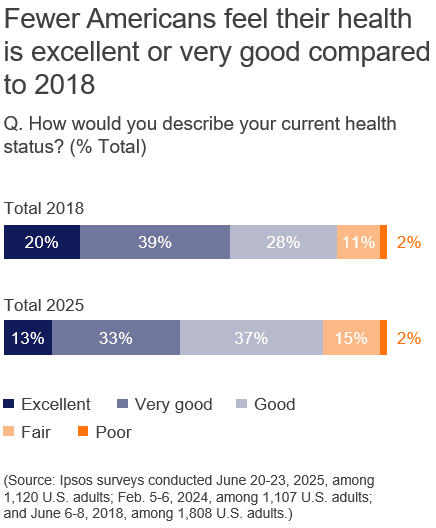
Another intersection of policy and personal realms manifests in shared beliefs. People tend to think they are healthy (though fewer than in 2018). Most people think they get seven hours of sleep a night.
Commonality on a big health concern: food
In a survey for Axios, nearly nine in ten (87%) people say the government should do more to make sure food is safe. This includes updating nutritional guidelines, adding labels to foods with artificial dyes or reducing exposure to pesticides. A similar number (90%) say it should be easier for the average American to understand food safety guidelines. Most agree that foods that contain pesticides or artificial food dyes aren’t safe to eat, even if they are approved by the U.S. Food and Drug Administration.
A plurality of Americans (38%) say the U.S. government should remove all artificial dyes from foods, even if it makes food cost more to use natural dyes. The problem is there’s a say-do gap. We say we want to live healthy lives, and many do. Yet there are still epidemics of obesity, diabetes, heart disease and related health issues.
Ebbing trust in the health system
Trust is what keeps public health working. Dr. Shereef Elnahal, who formerly served as under secretary for health at the Department of Veterans Affairs, told What the Future that trust is one of his key concerns when it comes to public health. He’s worried that if we don’t trust the people and institutions giving us recommendations, then we’re left fending for ourselves in this complicated and confusing space.
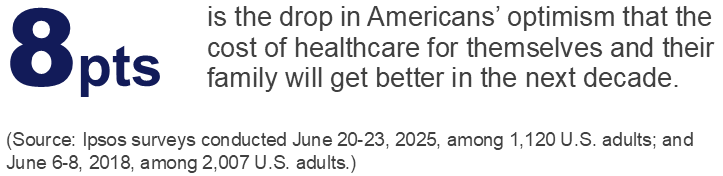
So it’s not great news that compared to 2018 fewer of us trust our doctors with our health data (74% vs. 83%) and fewer trust artificial intelligence with our medical data (27% vs. 39%). Two in three say they “do their own research” on health and nutrition topics, but 66% also think there is too much health information online, and they don’t know what to trust.
Trust and transparency
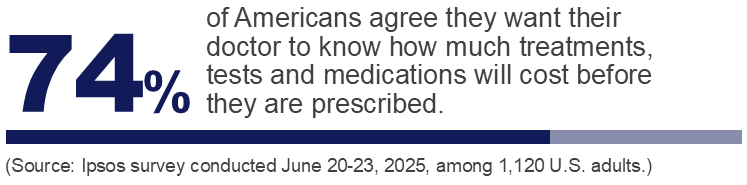
In the 2020 Truth issue of What the Future, leading trust expert Rachel Botsman said that transparency is often the antithesis of trust. But one place we’d like more transparency in a way that would likely build trust is in pricing. A large majority of Americans wish their doctors would tell them what treatments and medications would cost before prescribing them.
Wellness is a complicated topic bridging myriad disciplines and sectors. This intro hasn’t even talked about the many things that will have an impact in the future (though we’ll get into some of these later in the issue). GLP-1s are still a hot topic. Gene editing. Mental health. Biopharma. Menopause. The rise of AI in everything from personal wearables and monitors to China, which is creating AI-run hospitals and research labs.
Later in the issue we will talk about one of the macro forces at play in the future of wellness: the aging population. Aging is a global phenomenon, playing out in different ways in different regions. In the U.S., many people are living longer, healthier lives, which is amazing, and projections for life expectancy gains continue to stretch. Yet that comes with challenges. We face a caregiver shortage, rising costs, generational support issues and other challenges, especially when the rise in aging is coupled with a birth rate decline. As with all things, there are hopeful signs that technology can play a role in the future.
Wellness impacts policy, pharma, food, providers, insurers, caregivers, supplements, retailers and other sectors in various ways. But some questions cross all of those:
- At what point does a wellness trend or fad rise to the level where the system/industry should respond?
- How do you plan for plausible futures around public health and federally funded research?
- How much will AI disrupt everything from staffing to treatments to diagnosis to innovation?
- How do the companies in this space build (and rebuild) trust?
- How do we learn more about the specific health needs of traditionally underserved populations?
- Oh yeah, and how do we do all of this for an aging population?
How healthy we are in the future depends on how we answer those questions. But in the meantime, please don’t tape your mouth closed while you sleep no matter what you see on social media.
← Read previous | Read next → |