

Why helping boys and men doesn’t mean neglecting women’s issues

Many young men in the U.S. are failing to thrive economically and socially. But conversations about "men” and “masculinity” can, and perhaps should, be separate topics. One is an economic discussion. One is a cultural one. Richard Reeves is the author of “Of Boys and Men,” and president of the American Institute for Boys and Men. He looks at other parts of the world and sees strong social safety nets that include men. He has big ideas about what could work in the U.S. to turn things around for men, without slowing progress for women.

Matt Carmichael: Your book talks about how some systems favor men and others favor women, and we need to work on both. How challenging is that when many people view these issues as zero sum, that if women gain, men are losing?
Richard Reeves: That’s the central challenge, but once you get past it, you’re past it. There’s so much to do for women and girls. But we need to do stuff for boys and men. As long as people know that’s the frame, it can move quite quickly. But there’s an honorable feeling of discomfort. I think this should be a difficult conversation. Anybody that doesn’t find this conversation at least a little bit uncomfortable probably shouldn’t be in it.
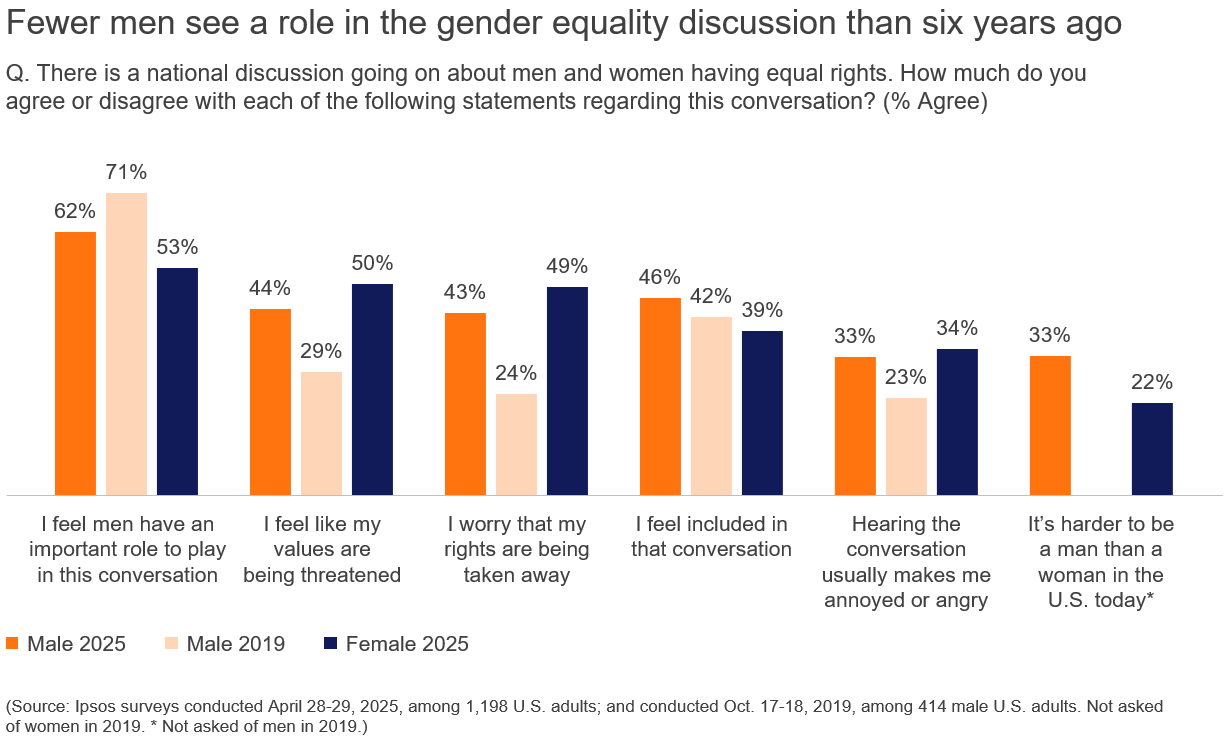
Carmichael: There’s a 10-point increase since 2019 among men that “hearing this conversation usually makes me annoyed or angry.” People are uncomfortable.
Reeves: People can be uncomfortable for different reasons. People fear, perhaps if they’re more on the center-left, that talking about boys and men means you’re going to start neglecting the issues of women and girls. Any discussion of problems facing boys and men is dismissed as not relevant. That does drive young men away. One of the reasons why a lot of young men have become less supportive of these discussions is because they feel that they are, at best, excluded from them and, at worst, blamed for them. They’re kind of over that.
Carmichael: One of the areas you address is caregiving. Why is that important?
Reeves: We have failed to adapt our labor market to a world where in most couples, both men and women work. Women are not as able to capitalize on their higher levels of education as they would be because the labor market continues to be somewhat rigged against women.
Carmichael: There’s momentum for bringing manufacturing jobs back to the U.S., but can we really return from the current knowledge/service economy?
Reeves: To an order of magnitude, no. Policy can have some effect on the structure of your economy. But these are deep structural forces in the economy that are very hard to change. It’s dangerous to promise too much of that because you can’t then do it. I think a lot of working-class men are going to get really hurt by the impact on the supply chains.
Carmichael: To what extent are screens to blame for so many young men not thriving?
Reeves: The negative effect of the online world for boys and men is the displacement effect. It’s that they’re not doing other stuff while they’re doing it. The online world has given boys and men a new place to retreat to. It’s interesting to me that the increase in the share of disengaged and disenchanted young men has coincided with the decline in the crime rate. That’s unprecedented. A plausible explanation for that is because they’re in the basement rather than on the streets.
 The negative effect of the online world for boys and men is the displacement effect. It’s that they’re not doing other stuff while they’re doing it.”
Carmichael: You talk a lot about intersectionality of race and gender. What do you see in the data?
Reeves: Researchers have found that the race gap was explained by the differences in the upward mobility rates for Black men. Black women and white women had similar upward mobility rates in individual income. All the race gap in upward mobility is explained by the difference between Black men and white men.
Carmichael: You offer a lot of solutions in your book, including giving boys an extra year of pre-K. How would that work?
Reeves: A lot of private schools already do it. They’ll have an extra year or extra months of pre-K and phase them in. I’m aware the practicality of it is difficult. At the very least, I think that should be an option. In terms of solutions, paid leave or extra investments in pre-K for boys or investments in extracurricular activities are public investments. Good public policy and appropriate investments are an essential part of restoring some of the lost ground for boys and men.
← Read previous | Read next → |