
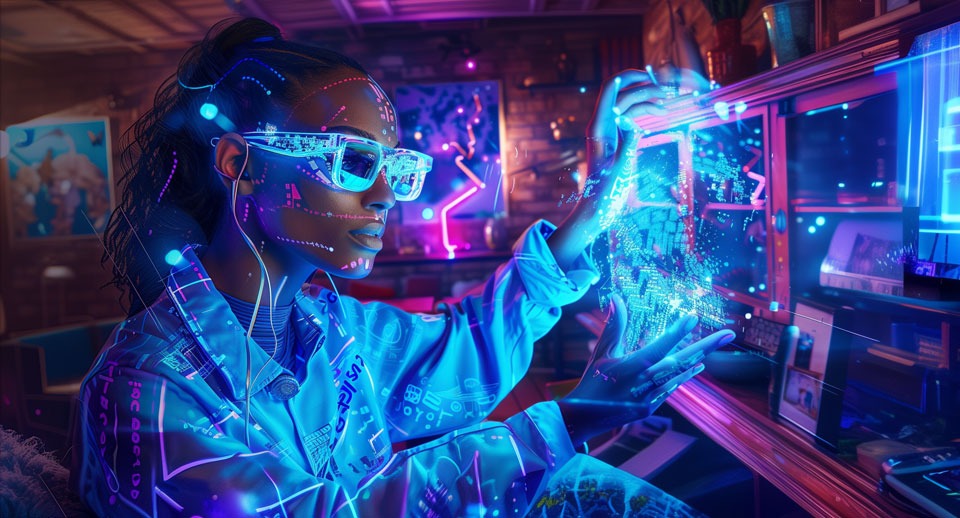
How AI could make platforms more inclusive for everyone
She says she’s not a techie, but Meta’s Victoria Ekwenuke loves the magic of technology and its ability to connect people to ideas across cultures and borders. She believes generative AI can democratize creativity and help amplify voices that often go unheard. But Ekwenuke also sees the potential for AI to reinforce old biases, stifle craftsmanship and spread disinformation. That’s why she says it’s critical to include the right people and to test, evaluate and revise systems to ensure that these models are inclusive and useful for all.

Kate MacArthur: What will the implementation of AI into platforms change for creators and their audiences?
Victoria Ekwenuke: Creators will have the potential to create more engaging content that could better resonate with their audiences. And the audiences then benefit by consuming content that might be more tailored or aligned to what they're looking for, whether they know it or not. But on the other hand, AI has the potential to stifle creativity. Technology has this unique ability to both inspire and atrophy skills. Maybe we're far away from the bad, but it is something we should be thinking about.
MacArthur: How so?
Ekwenuke: Some will say that AI is about working smarter, while others could say that we are losing sight of craftmanship. There was a time when you would have to put in time and work to truly master a skill. When I talk about atrophy, I'm talking about it in the sense of we’re building a muscle that's becoming accustomed to taking shortcuts. It's fast fashion, it's microwave culture.
I'm not sure how this is going to play out in the long run across industries and disciplines. Earning the right to say “I'm an expert” in something is still important. And there is conflict between these two things.
MacArthur: One of the bigger discussions about AI is that it’s not built on diverse and representative systems. What happens then?
Ekwenuke: The old saying that your output is only as good as your input truly stands the test of time and is extremely relevant here. Which is why when developing AI products, diversity of thought spanning culture, gender, age, experience and education is extremely crucial. We need to ensure we have the right people at the table to build this machine — which we know at the moment is not the case. We have to pay greater attention to this now for us to truly benefit from the full potential of what AI can mean for everyone.
MacArthur: How can platforms make that happen?
Ekwenuke: There should be some sort of iterative process where we are constantly testing, evaluating and then revising.
MacArthur: What can creators from under-represented backgrounds do in the meantime?
Ekwenuke: It's a virtuous cycle, right? Those creators, who are on the edge cases, those coming from underrepresented backgrounds, they have to use this tool with the mindset that they're also helping to build it. The thinking has to be, “I'm using it to get what I want from it, and I'm adding to the algorithm.”
MacArthur: How do you guide creators to keep it authentic and not change their content just to sell?
Ekwenuke: At Meta, there's an entire team dedicated to empowering creators. Now, there's nothing wrong with pivoting because there are many people, especially within this space, that are still finding themselves. Even when they want to switch [content], the guidance is to inform them to continue to be true to themselves because this will allow all the other success metrics to follow. So it’s, “Do I want to play the short game today and get all the clicks in the world, or am I trying to play the long game and have impact with the audiences that I'm serving?”
“The old saying that your output is only as good as your input truly stands the test of time and is extremely relevant here.”
MacArthur: With such diversity in the audiences on platforms, how do we ensure platforms work for everyone?
Ekwenuke: Empathy and having the ability to listen to your audience will help to ensure you’re reaching everyone. Yes, it's good to target. But even in targeting, you don't want to miss what you could learn from people outside of that target. It's not only about making people feel seen. We want people to feel valued, heard and understood.
MacArthur: We have a potentially divisive near-term future with elections and wars. How can people can manage through that?
Ekwenuke: I don't have the answers. We're at that nascent stage with AI, and there’s so much to unpack with this question. First, AI and tech in general have a huge role to play in shaping the future with integrity. When we talk about the dangers of AI and tech — like deep fakes and misinformation — naturally, there’s a lot of skepticism. Unfortunately, people and companies will need to be much more vigilant in deciphering what’s real versus not. When I think about emerging audiences beyond the election, for obvious reasons, AI won’t be embraced by everyone. I truly believe there’s a rising cohort of people who would rather go back to basics.
| ← Read previous Shifts: Creativity democratized, globalized and immersive | Read next → |