
How the AI revolution will reshape the ways we create, work and play
Imagine it’s 2034. Or you can have artificial intelligence imagine it for you! But how well will AI do that? Will it be as creative as humans can be? Or will we even care about this debate?
There has always been a push-pull between old ways of being creative and new ways. Is photography “art” the way a painting is? Is point-and-shoot photography still photography? Is Photoshop real enough? Are CGI effects still real cinema?
Roger Linn was a young guitarist who just wanted to be able to record his guitar riffs better, so he invented the drum machine. A third-order impact of which was essentially ’80s pop music. Legendary drummer for The Police, Stewart Copeland, interviewed Linn recently and said, “It’s fair to say that to many drummers he is Beelzebub himself.”
Enter generative AI.
Apple and Samsung recently traded commercials playing off (or inadvertently stoking) the fears that AI tools will crush traditional forms of creative expression. The Apple spot was viewed by many creative folks on many platforms as an affront, the very dystopia that the brand’s landmark “1984” was supposed to be shattering with its thrown hammer.
One way to think of creativity is a simple one: It’s about mastering the tools available to get the output you want. People still paint portraits even though they could take a photograph much faster. It’s all OK.
Creativity is newer than you think
It’s easy to think that cave dwellers were all like, “Hey, drawing animals on the wall is really creative. I’m just over here hunting and gathering food.” But according to Samuel W. Franklin’s “The Cult of Creativity,” summarized last year in The New Yorker, our fascination with creativity as an ideal only goes back to the decades following World War II. Franklin posits that creativity had two origins. One was in psychology as researchers tried to measure creativity as a companion to the way SAT tests measure intelligence.
The other was a business-driven desire to have creativity steering innovation and growth as a reaction to the “company man” ideal needed to power the nation through the Depression and a world war. Considering the future of creativity through that business lens, it’s no wonder companies are freaking out about generative AI.
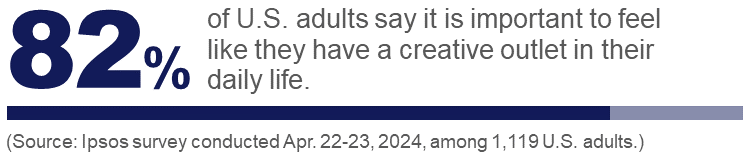
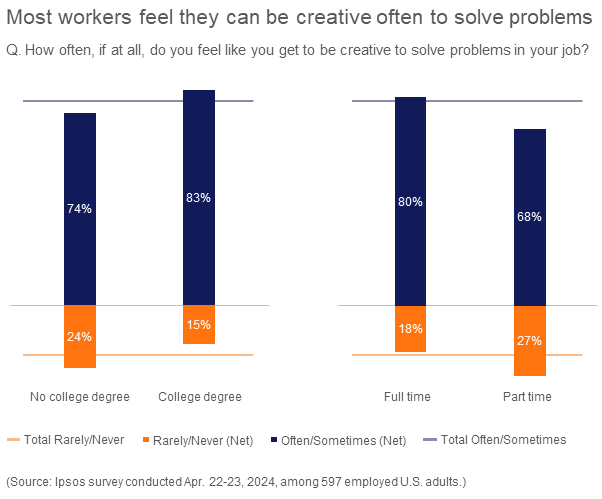
Today, 78% of workers say they get to be creative in some ways at their job. On one hand, if AI can help everyone be a bit more creative than they would otherwise by generating ideas and ready-made images and video — great! On the other hand, will there be a level of sameness and a derivative quality that dilutes creativity? Could generative AI lead to outputs that are less creative in the future?
Not that derivative can’t also be creative. Take the huge popularity of stories people write in existing creative universes (such as Harry Potter fan fiction). “The history of fanwork counters the image of a lone author producing work entirely on their own and releasing a finished polished work,” says Claudia Rebaza on behalf of the Organization for Transformative Works, a nonprofit that hosts the fanfic site the Archive of Our Own (AO3).
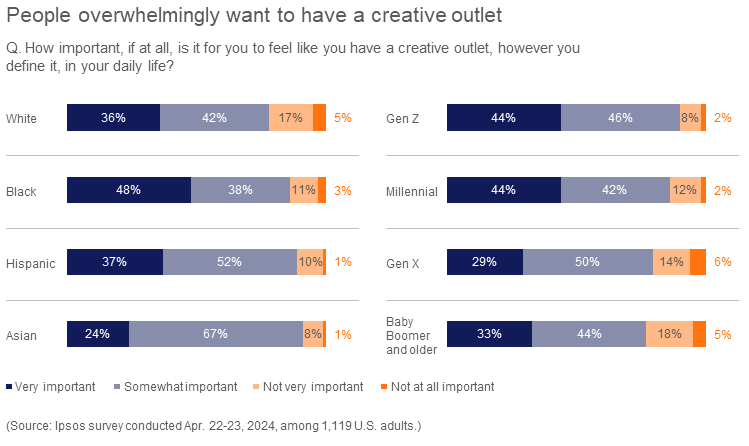
“Instead, there's the idea of a community of writers, readers and other creators all mingled together and interacting with one another on both specific works and general discussion and works which get produced piecework and in various states of ‘finished.’” Because in their hobbies people overwhelmingly want to be creative, too.
Fanfic’s proliferation is just one tiny niche of that, and yet remix culture is so huge that McDonald’s did an entire campaign — and even flipped the logo on its bags — nodding to it. If you know, you know, and if you don’t, you were really confused about what was going on.
Unleashing the bad
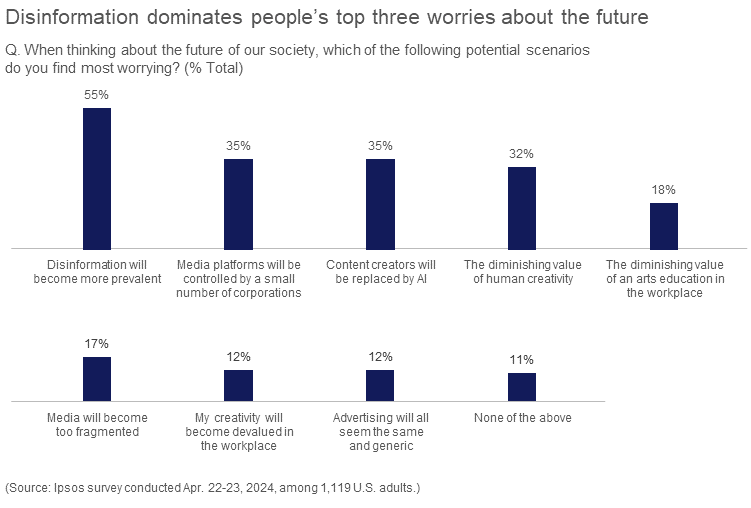
The dark side of AI creativity is that machines can create good as well as bad things. For instance, we’re worried about disinformation, which is likely warranted as AI can create believable things at unbelievable scale.
The push-and-pull of technology hits the fanfic community, too. On one hand, authors are mad that AI was trained on their works without any hint of compensation or credit or, frankly, mere permission.
“This is a contentious issue in fandom. There is no way we can say what fan creators as a whole or those on our platforms think about how AI may be affecting fanworks,” says OTW’s Rebaza. “There is always a risk in assuming that the most outspoken people represent the larger group. But it would seem the opinion is much more negative than positive.”
Yeah, but who cares?
That’s the billion-dollar question, right? If people can use AI to make an image or movie or song or, um, cough, a magazine that people want to enjoy –– what difference does it make? A lot of content on social media isn’t what you would ever describe as professional or polished, but people still watch and scroll.
Fanfic is original in a sense but also not in that it uses someone else’s characters and settings, just with novel story lines. And yet remixes are undeniably creative. Would an AI have thought to set an erotic story blending Lou Reed lyrics in the world of the Neal Stephenson’s novel “Seveneves”?
Probably not, but author NotHereNJ did!
As Rebaza says, “There is an audience for everything.” And there’s something to a point she made about how AI can democratize creativity. “The fact that works may be imperfect or brief or not easily grasped outside of a small group may be more of an incentive to others to create than something which is extremely well done. There's the idea that ‘I could do that too,’ or seeing positive responses may also encourage people who wouldn't have expected to find readers.”
Today anyone can turn a prompt into an image, video or song. Anyone can write an introduction to WTF, if you like phrases such as, “The future of creativity is a conversation, a collaboration between human and machine, a journey into the unknown.” Actually, that’s not entirely terrible.
History often hints at the future. In the past, tech disruptions led to more jobs being created than lost. There aren’t nearly as many darkroom techs as there used to be, but there are plenty of people creating photography. The thing here is that AI is disrupting so many creative (and less creative) professions all at once. That’s the part that will be hard to forecast.
We’ll see more Roger Linns be able to make music because they have AI drum machines. Ad agencies will be able to skip storyboards and use text-to-video to make 15 sample rough spots for clients to look over. Streaming music services and maybe AO3 will be flooded with AI works. But just as there are few arguments about whether photography is creative anymore, so too will discussion of “Is AI art?” likely fade.
There are practical as well as philosophical implications
For brands, the opportunities lie in helping people be creative, which is a nearly universal human value. There are also challenges in keeping brand voices authentic as marketing messages (and disinformation) proliferate.
For creators, how do you break through, and how do you make a living, if that’s your goal?
For platforms, there are opportunities in curation. One estimate says more than 300 million terabytes of data are created each day. That’s before these tools really take off.
But for those of us who create, the crazy misfits who think they can change the world, the good news might just be that the more human involvement, the more premium the works will become in any genre or medium or sector.
| ← Read previous Creativity is changing. Here’s what that means for creators, brands and platforms | Read next → |