
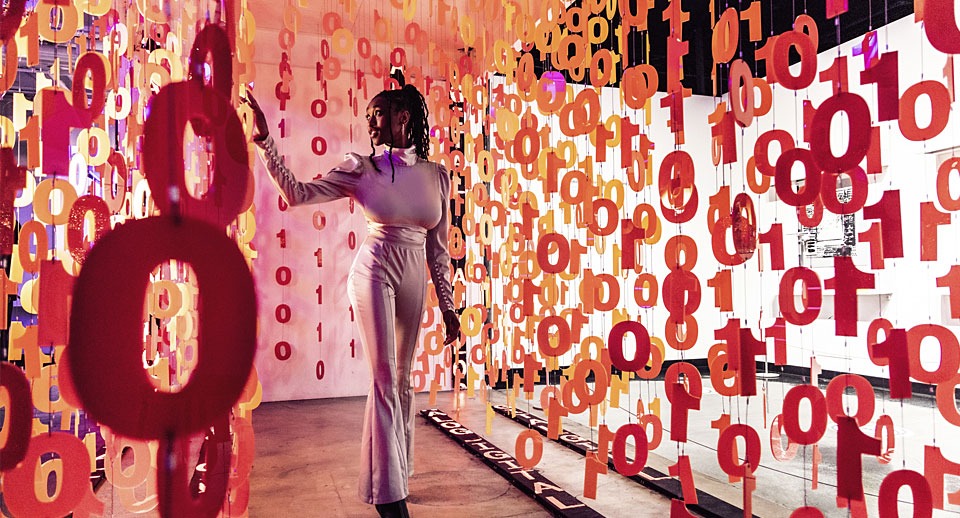
How digital venues are reshaping the way we experience arts and culture
Just as art is being disrupted by technology, so are cultural exhibits and attractions. The growth of immersive, digital art experiences like Meow Wolf, the Museum of Ice Cream and Color Factory are reshaping how we experience art, culture and science. Chris Freeman is president of the multisensory tech and art experience WNDR Museum, which opened in 2018 in Chicago. When he thinks what the future, he’s thinking how these venues will continually evolve, but always inspire awe and wonder.
Matt Carmichael: How do attractions like yours compare to legacy museums?
 Chris Freeman: There's a definition in Webster's [dictionary for museums], and we don't apply. If you apply how society or culture views a museum, we are there to stimulate thought and share creativity in a uniquely meaningful way, and we intend to elicit reactions in the same way that art does. A lot of what we do is art. We have makers and creators who create things with the intention of eliciting and extracting awe and wonder.
Carmichael: So in what category would you fit?
Freeman: The category that's become known as immersive experiential, which, depending on who you're talking to, we fit in or don’t. Where WNDR differentiates itself is we go a couple levels deeper in trying to connect with the guest and really invest in the experience with hospitality and bring that level of engagement. So trying to kinetically align and push together in a way that when two things collide — that is, the guest and our experience — that should impress awe on them and their group, and create wonder and excitement.
Carmichael: What do you call the things in your buildings?
Freeman: We've been calling them exhibits or the creative, but they are most definitely experiences.
Carmichael: Going back to Webster’s definition, museums are guardians of a collection of things. You don't have that legacy. What does that free you to do or constrain you from doing?
Freeman: We needed to say, “WNDR: come here for an experience” without saying that. So that's where the museum name came in. And out of the gate, we populated this building with one of the most prolific experiential artists, Yayoi Kusama, and that is a multimillion-dollar exhibit. That was WNDR’s privilege and pleasure to bring real, authentically credible, fine art as an entry to see the rest of the thing.
Carmichael: How do you balance the need to create these experiences but also satisfy peoples’ desire to make it Instagrammable?
Freeman: That is the most top-of-mind thought when we walk into work every day, especially the leadership of the company, because there are people that have charged us with, “You're an Instagram museum.” That is the perpetual split because we want to entertain, and with a certain segment of our population that comes in here, they want the art and they want to really live and breathe the maker, creator, artist side of this business.
“There are people that have charged us with, ‘You’re an Instagram museum.’”
Carmichael: You are creating an entirely new competitive set for legacy museums. How challenging is that for those museums?
Freeman: We don't necessarily consider anybody competition per se, depending on the audience that we're talking about, because the category is still so nascent.
Carmichael: Do you think traditional museums are going to become more experiential?
Freeman: There's a lot of trial and error going on. Some big whiffs out there, expensive ones, too. But there's a lot of cool and talented people doing stuff as well. I can throw out MSI [Museum of Science & Industry] as one of those companies.
Carmichael: What are AR and VR going to do to all these spaces?
Freeman: Everything has changed from exclusively visual to embedding a level of kineticism and touch and interactivity to the experience. Looking at some of the experiential stuff, it's nonstop stimulation. It's, “Try this taste this, smell that, do this,” and whoa, my senses are going crazy.
← Read previous | Read next → |