
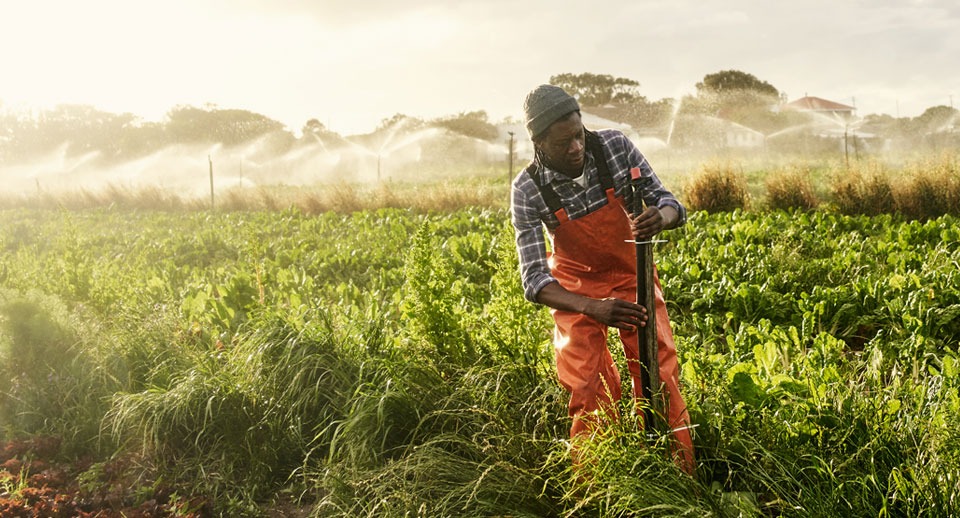
Why saving our water supply must be a priority for everyone
Farming issue
Feeding people requires immense amounts of water, whether to irrigate crops, nourish livestock or process all those source ingredients into the foods that people eat. Yet few people know that farming is one of the most water-demanding industries. But as the climate bakes the planet, farmers and food producers want agriculture to be part of the solution, doing more with less water and to restoring freshwater resources. That’s a major focus for Pilar Cruz, the chief sustainability officer of Cargill, one of the world’s largest food ingredient suppliers.
Kate MacArthur: How does agriculture’s demand for water shape how companies should manage their water use and pollution risk?
Pilar Cruz: We started by assessing our risks. A few years ago, we partnered with WRI [World Resources Institute], a well-respected research organization that prioritizes action where it is needed most, based on the specific challenges faced by local businesses, communities, and the surrounding region. Together, we developed a clear and well-defined water strategy for our company, which focuses on restoration, reduction of water pollutants and providing local communities with access to clean, safe water.
MacArthur: How important is water as a corporate or a strategic goal?
Cruz: Cargill has a comprehensive sustainability strategy that focuses on the three specific areas [where] we can have the greatest impact: climate change, land use and water, and people (or social sustainability). Our water strategy doesn’t just sit with me as Cargill’s CSO. It is a priority and business imperative for our board, our CEO, the executive team and our business leaders. And it isn’t just a priority for Cargill. We play a critical role in supporting the water goals of our customers like Walmart, Target, McDonald’s and PepsiCo.
MacArthur: What is the strategy?
Cruz: At Cargill, we have consistently adopted a local approach to this global crisis because water challenges are so different from place to place. In Thailand, for example, our solution links up nitrate-rich discharge water from a Cargill facility to nearby rice farms, providing a sustainable source of water and fertilizer. For each of our priority facilities around the world, and indeed for every water-stressed region, we believe there is an effective local solution found within agriculture.
MacArthur: How much power and influence do you actually have to drive change throughout the rest of the supply chain?
Cruz: It takes a village to bring water solutions to scale. We know we cannot do this alone. The more that we can use our position at the center of the world’s agricultural supply chain to bring companies, governments and NGOs together, the more we can scale effective solutions. We have very proactive strategic investments with non-governmental organizations such as WRI, The Nature Conservancy, the Tropical Forest Alliance, and WWF [World Wildlife Foundation] because they have capabilities and access to local networks that sometimes we may not have immediately within Cargill.
MacArthur: What is your most ambitious goal?
Cruz: Cargill’s commitment is to restore 600 billion liters of water around the world by 2030 and reduce water pollutants by 5 billion kilograms, which is huge. In addition, we have prioritized 72 facilities within our company where we are implementing water stewardship practices, and lastly, our commitment to reach 500,000 people in priority communities with safe drinking water by 2030. That would be the equivalent of almost twice the water that we use in our facilities in about a year or supplying water for a city of 10 million people for an entire year — think Seoul or London.
MacArthur: How are you thinking about how to adapt for future climate change?
Cruz: Regenerative agriculture is one of the programs that we are very optimistic about because we have seen clear, tangible benefits, both from a climate perspective but also in water restoration and water conservation. From a technology perspective, we are excited about more efficient irrigation systems. In Mexico, we have a program in place with corn farmers in Sonora and Sinaloa, which are two of the most drought-prone states in the country. By implementing these improved, more efficient irrigation systems, the farmers in Sinaloa and Sonora are seeing a reduction in water use by 30% to 50%, and that is huge. At the same time, they've seen an increase in yields by 10%, which is a nice improvement, too.
MacArthur: Can you give a specific example of how you’re using those systems?
Cruz: The sensors check for things such as humidity, the intensity of the sun in the field, and the best time looking at historical yields of productivity for farmers to irrigate.
|
← Read previous |
Read next → |