

What will we give up when AI shops for us?
 Read the full What the Future: Shopping issue
Part of shopping is functional. You need things. You buy things. You often buy the same things. But shopping also gives us other benefits: It can be social, it can be emotional, it can give us a reason to get out and make us feel accomplished by letting us check off to-dos.
And the things we buy are often part of how we show up in the world and show off our identities. Can an AI agent fulfill all of that? Can it at least pull off some aspects? Luca Cian, professor of Business Administration, studies this and more as he delves into consumer psychology at the University of Virginia’s Darden School of Business. Among AI researchers, he is best known for studying why people defer to AI in some decisions but not others. He thinks AI agents have a role to play in the future of shopping, but that brands are going to have to learn some new tricks and double down on old approaches to move us to an agentic future.
Matt Carmichael: What do you think agentic adoption is going to look like?
Luca Cian: Adoption is going to be uneven rather than necessarily slow. Some people will read the news and say, “I will never do this.” But most people will be curious and try it out for themselves. It’s also not going to be black and white. It will depend on the task.
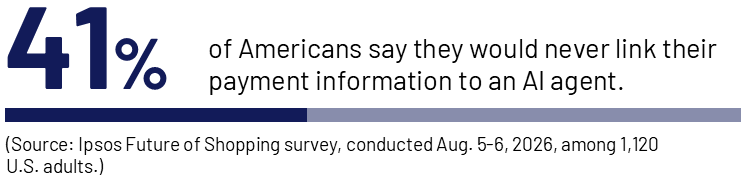
Carmichael: In our research, we see that people trust AI to research much more than they trust it to act. Are you seeing that?
Cian: Yes, and further, in my research, we found that people trust automation much more for something that is utilitarian in nature. There’s a fragility question, too. When an AI system fails, people generalize it to all AI systems, and there’s overall pushback on AI.
Carmichael: What do you think would create more trust?
Cian: One is control, like, can I have control in the decision? Can the AI always check back to me and say, “Is this OK if I do that?” Two is what we call a human in the loop. An AI agent will create more trust if, ironically, it is less agentic. Another thing is if companies are more transparent and more accountable.
Carmichael: People have gotten over qualms about new technology in the past. What will be different in terms of consumer psychology?
Cian: Agency is something that we, as humans, don’t want to give up. It makes us feel human. But delegation we do like. If an AI agent is framed as “delegation with my approval,” I think most people will be OK with that.

Carmichael: Psychologically, shopping gives us different rewards. Can agentic replace that?
Cian: Shopping is entertainment. Shopping is identity. Shopping is accomplishing a list, right? I think we will delegate agents only for the part of shopping we don’t want to do, like the boring, repetitive tasks. But for purchases that are connected to the identity and entertainment, we will do that because it's rewarding.
Carmichael: What other factors will play?
Cian: It will also be category dependent. Some people don't care about olive oil and will buy whatever is on the shelf. But I’m Italian. I love olive oil, and I research it and I want to have a specific olive oil. For me, it’s more fun.
 Agency is something that we, as humans, don’t want to give up. It makes us feel human. But delegation we do like. If an AI agent is framed as ‘delegation with my approval,’ I think most people will be OK with that.”
- Luca Cian, University of Virginia Darden School of Business
Carmichael: Yeah, I visited a supermarket in Italy that had an entire aisle of olive oil. It was overwhelming. Can AI help us with that and navigating the so-called paradox of choice?
Cian: If more choices are painful, agentic AI will relieve a lot. If I don’t have preferences and I have 100 options, agents can do the manual work there, which raises a whole massive billion-dollar question of how the agent picks their choices.
Carmichael: Given how personal shopping is, do agents need to learn consumer psychology, too?
Cian: I can see some companies saying, “We don’t care about moral compass. Just do whatever in your power to persuade the customer.” That’s scary, because it can read all the literature in consumer psychology and have a lot of data about the customer, specifically. If you don’t have a moral compass, you can use it to your advantage.
Carmichael: Will brand and loyalty still matter?
Cian: I don’t think loyalty will disappear. It will be important. If I tell my agent to do some shopping, but I say, “Hey, I have this brand I like,” loyalty will be important and will be a setting in agentic research. Brands still need to talk with you to have loyalty or emotional attachment.
← Read previous | Read next → |
For further reading: