Sharp improvement in economic optimism but little benefit for Conservatives who still trail significantly
- Ipsos Economic Optimism Index jumps from -31 to -4 in a month.
- But Labour retains large poll lead with 7 in 10 saying it is time for change at the next election.
The latest Ipsos Political Monitor, taken 8th to 14th May, 2024, explores public attitudes to the economy as well as Labour and the Conservatives.
Significant positive shift in economic optimism.
The Ipsos Economic Optimism Index has jumped to -4 this month up from -31 in April. 33% expect the economy to improve in the next year (+12pts from April), 37% think it will worsen (-15). Meanwhile, 25% think it will stay the same (+4) and 6% say it will make no difference (+1). This net score of -4 is the highest since August 2021.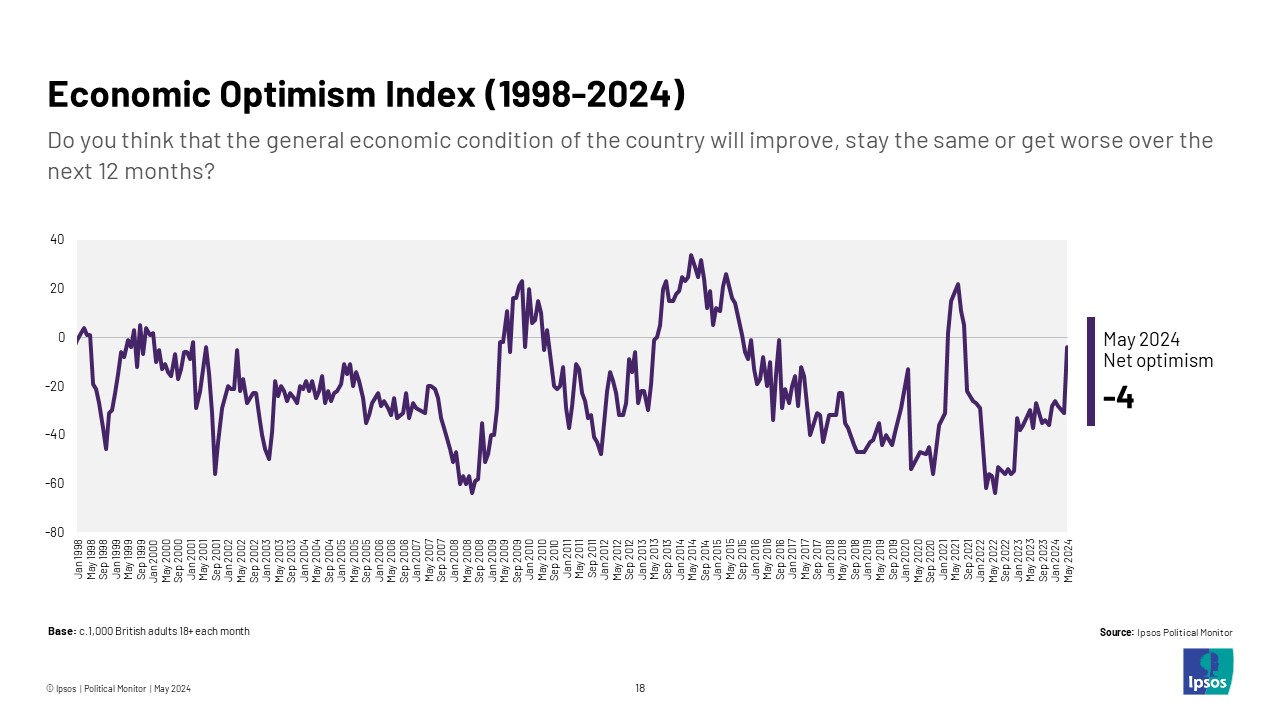
Optimism that the economy will improve has increased among nearly all groups but remains higher among men than women, by 38% to 29%, older than younger people (40% of 55+ compared to 27% of 18-34s), and owner occupiers compared to renters, 37% and 25% respectively.
It is lower in the North (28%) and Scotland (26%) than the rest of the country, 36%.
Labour retains a large poll lead over the Conservatives.
Labour retains a large poll lead over the Conservatives, although it has fallen slightly from 25 points to 21 points this month.
- Labour 41% (-3 from April)
- Conservatives 20% (+1)
- Lib Dems 11% (+2)
- Greens 11% (+2)
- Reform 9% (-4)
- Others 8% (+2)
Rishi Sunak’s leader satisfaction ratings remain poor, Keir Starmer’s improve.
- 7 in 10 are dissatisfied with the job Rishi Sunak is doing as Prime Minister (72%, -3 points from April). 17% are satisfied (+1 point). This means Rishi Sunak’s net rating has improved slightly from -59 to -55. 48% of Conservative voters are satisfied (-3) and 42% are dissatisfied (+5 points).
- Meanwhile, Keir Starmer’s net satisfaction rating has improved sharply to -18 from -31 last month. 32% are satisfied with the job the Labour leader is doing (+7 from April) and 50% are dissatisfied (-6).
7 in 10 think it is time for change as the Conservative government remains unpopular.
73% think it is time for change for change at the next General Election. This is up 4 points from January and 8 points from July last year). The 73% saying it is time for change includes 65% who say the Conservatives have done a bad job in government and it is time for change and 8% who say they have done a good job but it is still time for change. 
This strong sentiment that it is time for change is likely driven by negative public perceptions of the current Conservative government. For example:
- 81% are dissatisfied with the way the government is running the country (-3 pts from April), 12% are satisfied (+2). 58% of current Conservative voters are dissatisfied (+2).
- 66% disagree the Conservative government deserves to be re-elected (+6pts from January). 14% agree it does (-5).
- 68% disagree that ‘competent’ is an accurate description of the current government (+4pts from January). 14% agree it is an accurate description (-4).
Gideon Skinner, Head of Political Research at Ipsos, said:
The Conservatives may be encouraged that the improvement in economic optimism this month will bolster their argument the British economy has turned a corner. But the danger signs still overshadow these shoots of hope. The improvement will need to be sustained, and not just a short-term reaction to the news that the UK economy is out of recession. Even then, the Conservatives face big challenges, with strong time for a change sentiment, negativity towards the party and concerns about delivery on other key areas like public services and immigration also contributing to Labour’s large poll lead. Rishi Sunak may feel rising economic optimism is a necessary condition of improving the Conservatives' fortunes - but it may not be a sufficient one.
Technical note
Ipsos interviewed a representative sample of 1,008 adults aged 18+ across Great Britain. Interviews were conducted by telephone between the 8th – 14th May 2024. Data are weighted to match the profile of the population. All polls are subject to a wide range of potential sources of error.